For Parents Of Kids Who Constantly Stare At Screens...
Your Child's Brain Is Capable Of Amazing Things... But It's Hijacked By Billion-Dollar Companies
Help Them Break Free Of The Screen & Unlock Their Full Potential With THIS...
In Just 28 Days!
It works with kids aged 3+ and it's surprisingly effective even if you feel like you've tried everything.
What If I Told You That Your Child Isn't "Addicted" to Screens...
...Their Brain Has Simply Been Hijacked by Billion-Dollar Companies?
Let me ask you something.
When your child throws a tantrum because you asked them to put down the iPad...
When they can't seem to focus on anything that doesn't have a glowing screen...
When they beg for "just five more minutes" from the moment they wake up until they finally fall asleep...
Do you blame yourself?
Do you wonder if you're a "bad parent"? (Hint: You're not.)
Do you lie awake at night worrying about what all this screen time is doing to their developing brain?
If so, I have something important to tell you: It's not your fault.
And it's not your child's fault either.
The truth is, you're fighting an invisible war against some of the smartest neuroscientists and behavioral psychologists on the planet.
And until today, you've been doing it completely unarmed.
"These companies employ armies of attention engineers whose job is to make their apps as addictive as possible. They're using every psychological trick in the book—and inventing new ones—to capture and hold your child's attention."
Main Benefits You'll Enjoy
🧠 Brain Reset
Watch your child's brain "reset" as real-world activities become rewarding again... Naturally, without forcing it!
😌End the Battles
End the begging, tantrums, and meltdowns that erupt every time you say "no" to screens
🌳 Rediscover Play
Rediscover the joy of outdoor play, reading, and imagination as your kids willingly choose real-world activities over screens
🕊️ Calm Parenting
Stop yelling, threatening, and bargaining about screen time—and finally feel like a calm, confident parent
💤 Better Sleep
Give everyone better sleep with phone-free bedrooms that transform morning routines
❤️ Rebuild Connection
Rebuild the family connection you thought you'd lost with dinners full of conversation and kids who actually want to spend time with you
The Real Reason Your Child Is "Addicted" to Screens
(Hint: It Has Nothing to Do With Weak Willpower)
Here's something that changed everything for me:
Every time your child gets a like on Instagram, completes a level in a video game, or watches a funny TikTok, their brain releases a hit of dopamine... the "feel-good" chemical that says, "This is rewarding! Do it again!"
This isn't new.
Our brains evolved this way to motivate us toward things that help us survive—food, social connection, accomplishment.
But here's the problem:
Screens are designed to hijack this system.
Tech companies employ neuroscientists and behavioral psychologists whose entire job is to make apps as addictive as possible.
Variable rewards. Infinite scroll. Autoplay. Notifications.
All of these are deliberately designed to keep your child coming back.
And here's the scary part...
The Neuroscience: What Screens Are Actually Doing to Your Child's Brain
Studies from Yale and UCLA show that excessive screen time literally rewires the prefrontal cortex... the part of the brain responsible for impulse control, focus, and decision-making.
The more screen time, the weaker this area becomes.
And the weaker it becomes, the harder it is to resist screens.
It's a vicious cycle.
This Is Why Everything You've Tried Has Failed
If you're like most parents I work with, you've probably tried:
Lecturing - About why screens are bad... It doesn't work because you're appealing to the prefrontal cortex... which is exactly what screens have weakened!
Confiscating Devices - Creates temporary compliance but doesn't build internal regulation. The moment they get access again, they're right back where they started!
Punishments & Threats - Makes them associate YOU with the restriction, not the screen habit itself!
Relying On 'Willpower' - Fails because you're asking their brain to resist something it's been chemically programmed to crave!
None of these work. And it's not because you're doing them wrong.
It's because you're fighting billion-dollar apps with 20th-century parenting techniques.
Research Shows: There Are Dire Consequences of NOT Fixing This Now!
I'm not trying to scare you. But you deserve to know what the science says...
👉 Their Brain Development Suffers: Excessive screen time may cause shrinkage in key brain regions affecting impulse control and focus [1]
👉 Their Mental Health Declines: Children with high screen time are more likely to experience anxiety and depression, with difficulty regulating emotions [2]
👉 Their Self-Esteem Gets Hurt: Constant social comparison on screens can lead to lower confidence and feelings of worthlessness [3]
👉 Their Academic Performance Takes A Nose-Dive: Screen-addicted kids often struggle in school due to weakened focus and information retention [4]
👉 Their Sleep Gets Disrupted: Blue light from screens suppresses melatonin, leading to chronic sleep deprivation that affects every aspect of development [5]
And perhaps worst of all? You lose your relationship with your child. They'd rather stare at a screen than talk to you. They become irritable, distant, and disconnected.
The good news? You can reverse all of this. But it takes the right approach.
What Makes This Program So Different From Everything You've Tried
Most screen time "solutions" fail because they treat the symptom, not the cause.
They tell you to "set limits" or "be consistent"—as if you haven't tried that a thousand times already.
The 3-Phase Dopamine Reset System™ is different.
Instead of fighting your child's brain chemistry, it works with it.
Here's what makes it unique:
The Dopamine Detox Protocol: Resensitizes your child's reward system so real-world activities become genuinely enjoyable again
The Friction Formula: Redesigns your environment to make screens harder to access and real-world play easier (without constant supervision)
The Token Economy System: Transforms screen time from an entitlement into something they earn... eliminating 90% of daily negotiations
The Relapse Prevention Framework: Prepares you for weak moments (travel, illness, holidays) so one bad day doesn't undo weeks of progress!
This isn't about being a stricter parent.
It's about being a smarter one.
Thousands of Families Have Already Made the Transformation
⭐⭐⭐⭐⭐
"Within 72 hours, the begging stopped. By day 7, my kids were actually ASKING to go outside. I never thought
I'd see the day. This system just...
works.
— Jessica M., mom of 3
✓ Verified Customer
⭐⭐⭐⭐⭐
"I was skeptical because we'd tried EVERYTHING. But the science-based approach made sense, and the daily emails kept me accountable. Our home is so much calmer now
— Sarah R., mom of 2
✓ Verified Customer
⭐⭐⭐⭐⭐
"My 8-year-old used to have COMPLETE meltdowns when I said no to screens. Now she accepts boundaries without drama. The Token Economy was a game-changer for us
— Amanda T., mom of 2
✓ Verified Customer
⭐⭐⭐⭐⭐
"The best part? I finally got my husband on board using the Phase 3 strategies. We're a united front now, and the kids have stopped playing us against each other."
— Diana P., mom of 3
✓ Verified Customer
⭐⭐⭐⭐⭐
"The daily emails were perfect... 5 minutes to read, 10 minutes to implement. As a working mom, I don't have time for lengthy courses. This was exactly what I needed
— Lauren H., working mom
✓ Verified Customer
⭐⭐⭐⭐⭐
"Honestly I wasn't impressed at first, but then I read the email they sent on day 7 and it completely changed the way I look at my kid's screen time... This approach just works!
— Kara W., mom of 1
✓ Verified Customer
From Overwhelmed Mom to Screen-Time Expert

Hi, I'm Nora Friedman—founder of The Calm Family.
But working with screens wasn't always easy for me.
In fact, I used to BE the overwhelmed mom drowning in screen time battles.
Before I developed this system, I had three kids completely glued to their devices:
My oldest was sneaking his iPad at 2am
My middle child was having explosive meltdowns when I asked her to stop watching YouTube
My youngest wouldn't even look up from his tablet during dinner
I tried EVERYTHING:
Hiding the devices (they found them)
Setting timers (they ignored them)
Taking screens away completely (lasted 2 days before I caved)
Bribing them with rewards (made it worse)
Yelling and threatening (destroyed our relationship)
Nothing worked. And I felt like the worst parent on earth.
But then something changed.
I met a few families who had somehow eliminated screen addiction without the battles. Their kids played outside for hours. Read books voluntarily. Went to bed without sneaking devices.
So I became obsessed with figuring out what they knew that I didn't.
I dove deep into the research...
Neuroscience on dopamine, behavioral psychology, and child development studies. I tested what worked and what didn't on my own kids.
And over time, I discovered a simple three-phase system that anyone can use to break screen addiction.
Even if you're exhausted, overwhelmed, and feel like you've already tried everything.
Now I've helped over 1,000 families implement it
Introducing...
 Rated 4.7/5 by 127+ parents

The 28-Day Screen-Free Kids Challenge™
Transform Your Child's Screen Addiction Into Real-World Living
Without Yelling, Bribes, or Daily Battles
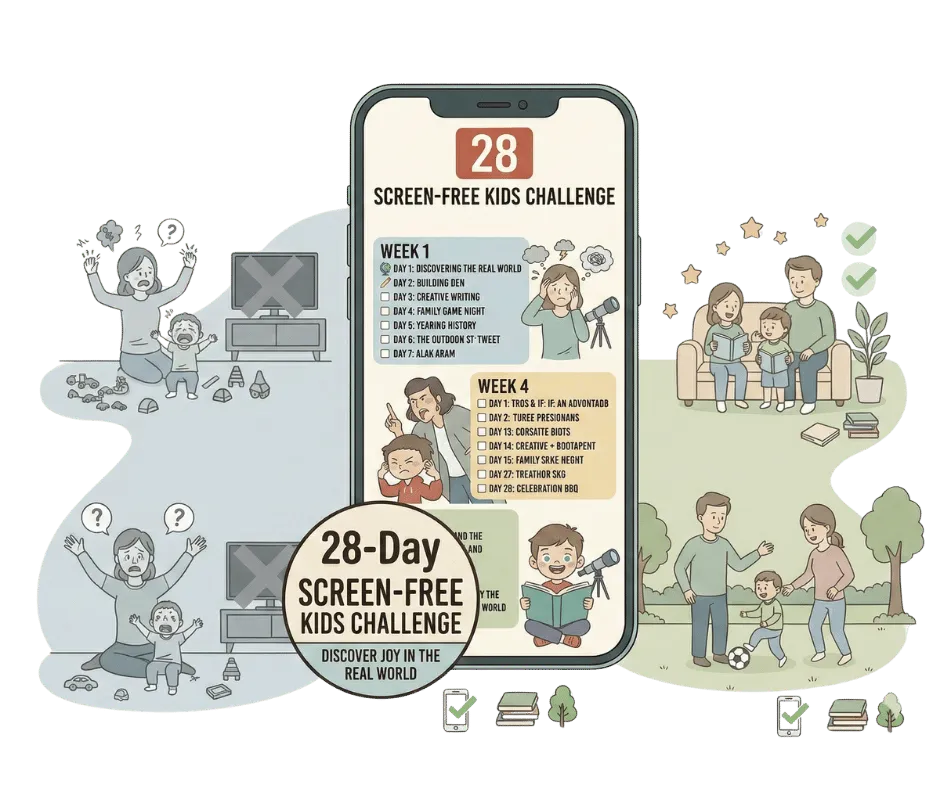

PHASE 1: THE DETOX (Days 1-7)
Reset your child's dopamine receptors and break the addiction cycle
The 72-Hour Dopamine Detox that resensitizes their brain's reward system
The Friction Formula for environmental redesign (add friction to screens, remove friction from real activities)
The Screen Time Contract with clear boundaries your child helps design
Tech-Free Zones that make screens physically harder to access
Result: Within 3-7 days, you'll see less begging for screens, longer attention spans, and calmer behavior.

PHASE 1: THE REPLACEMENT (Days 8-21)
Fill the void with enriching activities that develop your child naturally
The Phone-Free Bedroom Game (improves sleep quality by 70% within the first week)
The 1-Hour Outdoor Play Trick (natural dopamine that's BETTER than screens)
The Content Quality Upgrade (proven ways to eliminate garbage-tier content like TikTok and YouTube Shorts)
Weekend Reset Protocols (prevents the "weekend binge" that destroys the whole weeks' progress)
Result: Screen time naturally decreases because kids are engaged in better activities. Homework improves. Sleep improves. Mood improves.

PHASE 3: THE LONG-TERM SYSTEM (Days 22-28+)
Lock in the new normal and prevent relapse
Partnership Alignment Strategies (get your spouse/co-parent fully on board)
The Long-Term Relapse Prevention Plan with IF-THEN strategies for weak moments
Social Pressure Solutions (handle "But everyone else gets unlimited screen time!" with ease)
High-Risk Situation Planning (so travel, illness, and holidays don't end up causing problems you've already solved)
Result: The new screen philosophy become your family's lifestyle. Not a temporary fix. Kids trust "it's how we do things"
Here's Everything You'll Receive:
28 Daily Email Lessons
With specific action steps (5 minutes to read, 10-15 minutes to implement)
The Complete 3-Phase System
Taking you from Detox to Replacement to Long-Term Support
50+ Practical Examples
For every age group (from toddlers to teens)
Word-for-Word Scripts
For handling resistance, tantrums, and "but everyone else gets unlimited screens!"
The Screen Time Contract Template
That your child helps create tailored to your specific situation (because ownership = compliance)
The Token Economy Blueprint
This alone eliminates daily negotiations and tiresome tantrums that cause busy parents to give in
Lifetime Support
To all current Screen-Free Challenge materials and its future updates
Stops Screen-Time Battles For Good
Get Lifetime Access to the Complete 3-Phase Dopamine Reset System™ and more...
You're On The Right Track To Unlock...
The 28-Day Screen-Free Kids Challenge™
Recap Of Everything Inside:
The 28-Day Screen-Free Kids Challenge is NOT another course...
It's a complete system that...
Rewires your child's dopamine system: using the same neuroscience tech companies use to hook kids, now working for you
Ends screen battles without cold turkey: gives your child's brain equal rewards to replace screens
A clear action plan for all 28 days: no guessing, no falling back into old patterns
Turns your child into a self-regulating kid: who earns screen time and chooses real life without force
Aligns your whole family: one unified system that holds even on the hardest days
How Much Time It Takes...
Just 28 days following simple tools and tricks delivered to your inbox every morning
Few minutes a day to use the tools and follow along
Daily progress so you're never left without support and feelings of accomplishment
How It's Delivered...
Sent straight to your inbox so you can skim through in the morning and follow along
Read or listen on any device you'll use during the day anyway
Lifetime access to all challenge materials as long as we're in business
Comes with a 30-Day Money-Back Guarantee so you can give it an honest try
Offer Ends in:
List price: $49
Bonus price: $155
Total value: $204
SPECIAL SALE: $27
Plus, You'll Get These 5 FREE Bonuses
($150+ Total Value)
🎁 BONUS #1
The 3-Day Quickstart Checklist
(Value: $27)
See results FAST... within 72 hours. This condensed action plan lets you start immediately without reading the full system first.
🎁 BONUS #2
The Calm Mom Starter Pack
(Value: $27)
Affirmations and mini daily rituals to help YOU stay calm during the transition. Because you can't pour from an empty cup.
🎁 BONUS #3
The Screen Time Results Tracker
(Value: $17)
Your Google Sheets template that shows you exactly how much time you're reclaiming. Nothing motivates like seeing the numbers.
🎁 BONUS #4
The Done-for-You Detox Schedule
(Value: $37)
For busy moms & dads who don't have time to plan. We've mapped out the entire 28 days for easy implementation.
🎁 BONUS #5
The Partnership Alignment Pack
(Value: $47)
Word-for-word scripts for getting your spouse or co-parent on board. Even if they're resistant. Includes the exact conversation framework that's worked for other families before you.
🎁 BONUS #6
Priority Workshop Invites
(Value: Off-the-Charts)
Our Challengers are the very first people we'll invite to exclusive year-round workshops we host when seats are limited.
Offer Ends in:
List price: $49
Bonus price: $155
Total value: $204
SPECIAL SALE: $27

30-Day Money-Back Guarantee
I'm so confident that this challenge will help you significantly reduce or even
eliminate screen time battles that I'm giving you a completely risk-free offer.
If you implement this system for 28 days and don't see a dramatic
reduction in screen time, begging, tantrums and overall don't enjoy a calmer behavior...
Just email me at [email protected] and I'll refund your purchase.
No questions asked. No hoops to jump through.
We stand behind this programs unconditionally because our customer satisfaction rates are incredibly high.
There's nothing to lose.
And everything to gain..
Frequently Asked Questions
We understand lorem ipsum dolor sit amet, consectetur adipisicing elit.
Question 1: What ages does this work for?
The system works for children ages 3 through 18. We provide specific modifications and examples for toddlers, elementary schoolers, tweens, and teens.
Question 2: What if my spouse/partner isn't on board?
Phase 3 specifically addresses partnership alignment with proven strategies to get even resistant co-parents on board. Many families have implemented this successfully even when starting with only one parent committed.
Question 3: I've tried everything and failed. How is this different?
Most parents fail because they rely on willpower and punishment… which don't work against billion-dollar apps designed by neuroscientists. This system is based on the same neuroscience and focuses on REPLACING screens with rewarding alternatives. It works WITH your child's brain, not against it.
Question 4: How much time does this take each day?
Just 10-15 minutes per day. You'll receive one email each morning with a simple action step. 5 minutes to read, 10 minutes to implement. This is designed for busy parents who don't have hours to spare.
Question 5: What if I don't have time to start right now?
The emails will wait for you. You get lifetime access. But consider this: how much time (and stress) would you SAVE if you didn't have to fight screen battles every day? Most parents find the 10-15 minutes invested saves hours of conflict.
Question 6: What if I'm not satisfied?
Email me within 30 days for a full refund. No questions asked. I'm confident this will work for you because I've seen it work for hundreds of families. But if it doesn't meet your expectations, you get every penny back.
Don't Wait Another Day
Every day you wait is another day your child's brain is being rewired by screens.
Every day you wait is another day of tantrums, battles, and disconnection.
You don't have to feel this way anymore.
Click the button below right now and join The 28-Day Screen-Free Kids Challenge.
Your family deserves peace. And you deserve to feel like the calm, confident parent you were meant to be.
I'll see you on the inside.
— Nora Friedman
Founder, The Calm Family
REFERENCES;
[1] Takeuchi, H., et al. (2015). Impact of screen time on brain development. Human Brain Mapping.
[2] Twenge, J. M., & Campbell, W. K. (2018). Associations between screen time and lower psychological well-being among children and adolescents. Preventive Medicine Reports.
[3] Kelly, Y., et al. (2019). Social media use and adolescent mental health. The Lancet.
[4] Adelantado-Renau, M., et al. (2019). Association between screen time and academic performance. JAMA Pediatrics.
[5] Chang, A. M., et al. (2015). Evening use of light-emitting eReaders negatively affects sleep. PNAS..
The Calm Family
thecalmfamily.com
Questions? [email protected]
© The Calm Family | All Rights Reserved
Results may vary. This program provides education and tools for parents. Individual family outcomes depend on implementation and consistency.